If you’re planning a wedding right now, you already know: everything costs more. Every bride and her family is feeling that pressure, and it makes complete sense to compare quotes carefully and push back on anything that looks too high.
This post is about a conversation I had recently with a bride who did exactly that — and what we discovered together when we walked through the numbers. But before I get to the math, I want to start with the question I asked her first.
What do your guests actually experience at a wedding?
Think about it from their perspective. They got dressed up, drove across town, gave you a gift, and showed up to celebrate one of the most important days of your life. What they experience that evening comes down to four things:
🍽️ Food — The primary driver of the guest experience. In South Louisiana, food is the culture — it is how we show hospitality and honor the people in the room. It is what guests talk about for years.
🥂 Drinks — The social element of any great celebration. The bar experience shapes the energy of the evening.
🎶 Music — Sets the tone and energy all evening. The right music turns a reception into a celebration.
🏛️ Venue & Ambiance — The atmosphere guests live in for the entire evening — from arrival to send-off. The design of the space, the feel of the ceremony area, the courtyard, the ballroom. And in Louisiana, whether the space is actually built for celebrating — for dancing, for the energy of a room full of people who came to have a great time.
Food. Drinks. Music. And the venue itself — the atmosphere, the ambiance, the feel of the space they spend their entire evening in.
The flowers, the decor, the centerpieces, the details — those matter deeply to the couple, and they should. But the guest experience is those four elements. And in South Louisiana, food is the dominant one. It’s the culture. It’s how we show hospitality and honor the people who showed up for you. It’s what gets talked about for years.
So when you’re comparing venue quotes, those four elements are the right framework. Let me walk you through what that looks like in practice.
“You’re $2,638 more expensive.”
That’s how the conversation started. She had two quotes. The gap was real. I told her what I tell every bride in this situation: let’s walk through what each quote actually delivers on those four elements before we talk about the totals.
On drinks — both venues offered comparable full bar packages. A tie.
On music — both quotes had DJ service priced in, so that element was a tie.
On venue and ambiance — let me be straightforward about this, because honesty builds more trust than spin.
Some venues in our area have beautiful outdoor landscaping — mature trees, garden grounds, spaces that look stunning in photographs. We completely understand why brides are drawn to that. That aesthetic is genuinely appealing, and it’s exactly why we thought carefully about our own approach.
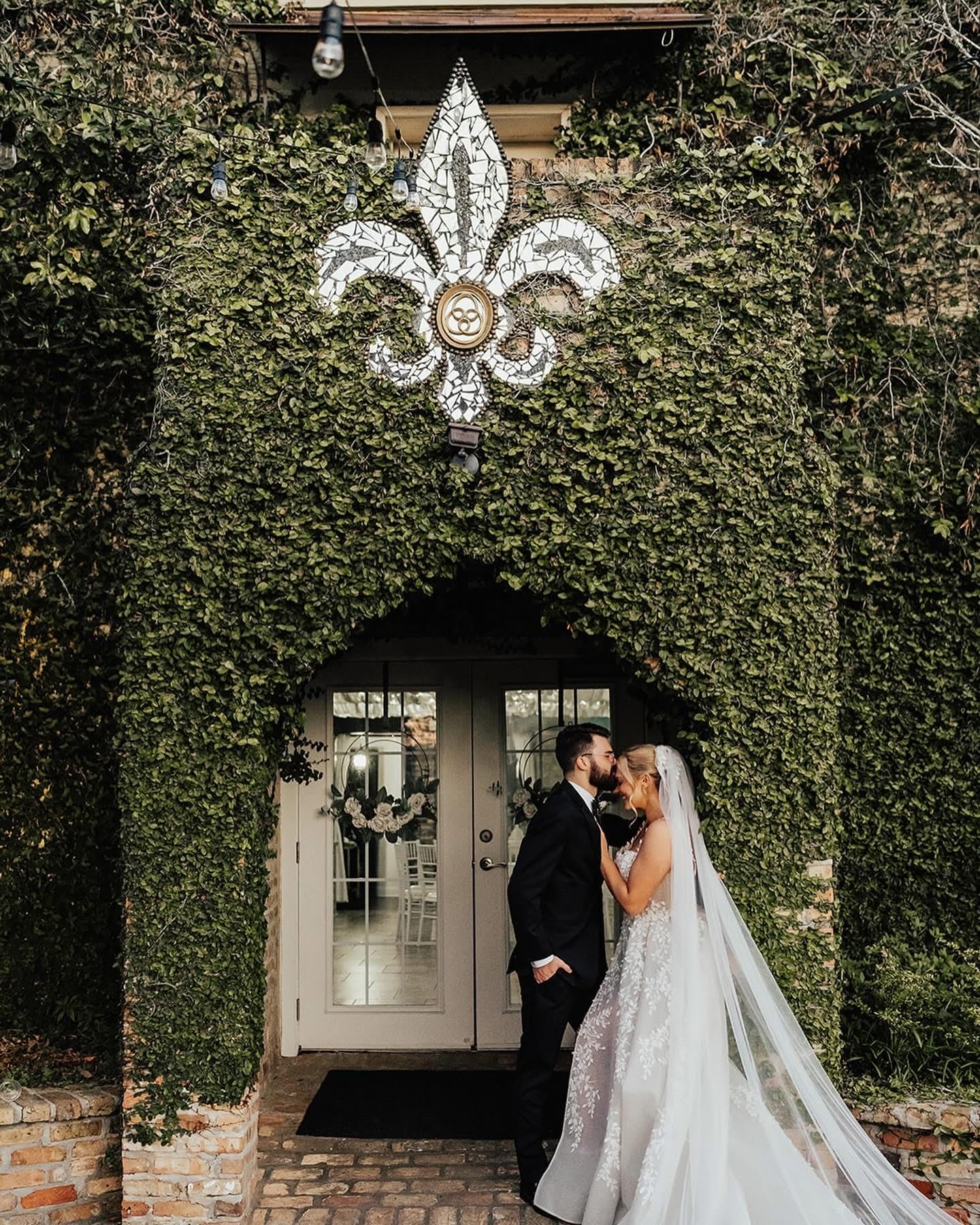
At Fleur de Lis, our design philosophy is the feeling of being outside at night in New Orleans. Our courtyards are real outdoor spaces — open to the sky, surrounded by brick walls lined with greenery and trees, with sun shades overhead that provide coverage without closing the space off. The result is that New Orleans courtyard atmosphere: intimate, garden-like, romantic, perfect for ceremony photographs — in a space that was purpose-built for a wedding rather than borrowed from the surrounding landscape.
The distinction matters for two reasons.
First: noise. Some venues with outdoor ceremony spaces are located directly adjacent to busy roads — highway traffic running right alongside the ceremony area with no meaningful barrier between your guests and the road. A ceremony is the most important thirty minutes of a wedding day. The setting should honor that moment. Our courtyards are enclosed by brick walls that naturally buffer the surrounding environment.
Second: weather. South Louisiana is beautiful and unpredictable. When it rains, a fully exposed outdoor ceremony space doesn’t just lose its appeal — it creates a real logistical problem. Guests arriving across an unpaved parking area in the rain — that experience starts the evening on the wrong note. Our courtyards have brick floors and sun shade coverage overhead. An unexpected shower doesn’t change the experience your guests have.
Then there’s what happens after the ceremony. And this is where venue design matters most of all.
We’re in Louisiana. We don’t just attend weddings — we celebrate them. Mardi Gras, Jazz Fest, second lines, family gatherings — our entire culture is built around food, drinks, music, and dancing. A Louisiana wedding reception isn’t a formal dinner you sit through. It’s a party. And not every venue is built for that.
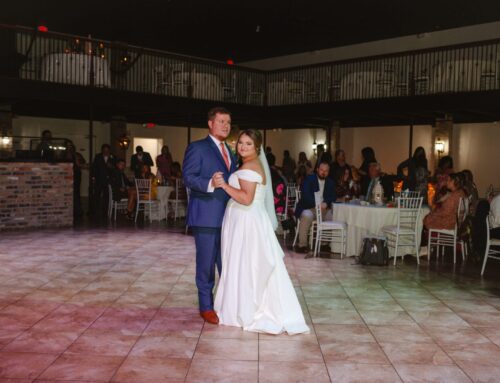
Our ballrooms were designed from the ground up around the celebration — not just the photographs. No windows means the lighting environment is completely controllable. We can take the room from bright and welcoming during dinner to the proper low-energy atmosphere that gets people on the dance floor — and keep it there all night. Our theatrical lighting system is designed specifically to create that energy. The layout encourages movement. The whole space is oriented around the idea that when the music starts, your guests should want to dance.
Some venues are beautiful for photographs and awkward for dancing. A room full of windows at night, ambient light that can’t be controlled, a layout that keeps guests seated and static — those aren’t design flaws, but they’re real considerations for a Louisiana wedding where the reception is expected to become a genuine celebration.
Our ballrooms carry the outside-at-night-in-New-Orleans philosophy all the way through — starry ceilings, gas-lit ambiance — and they were built to hold the energy of a room full of people who came to have a great time.
Then we looked at the food.
The competitor’s package passed 3 appetizers — selected from a list of 8 options, none of which include seafood. In our experience with Louisiana cocktail wedding catering, 3 passed items is the minimum standard, 5 to 7 is a strong standard, and 8 to 10 is luxury — with at least 2 seafood items expected for a South Louisiana reception.
Their buffet: 2 entree picks and 2 side picks. No gumbo — at a Louisiana wedding, gumbo is culturally expected, not a specialty item. Gumbo was $4 to $5 per guest extra. Salad was $3 per guest extra. No staffed action station at any price at this tier.
Our Grand Wedding Food Package passed 18 items — our staff walks them personally to every guest throughout the entire evening. 7 of those 18 are seafood: Crab Cakes, Bacon Wrapped Shrimp, Fried Shrimp, Crawfish Kickers, Crab Rangoon’s, Shrimp Egg Rolls, and Fried Fish. We’re at nearly double the luxury benchmark.
Then a full buffet: Seafood Gumbo with Rice, Shrimp Roban Pasta, Cajun Jambalaya, Florentine Ravioli, Twice Baked Potatoes, Assorted Fruits and Cheeses, and Caesar Salad. Plus a staffed action station where our team serves Shrimp and Grits and Grits and Grillades directly to guests throughout the reception.
I priced the food difference using the competitor’s own specialty menu pricing to match our Grand Wedding Food Package. For 125 guests: $7,190 in food upgrades — not even considering their 20% staffing charge and tax. When those are applied, the food difference comes to $9,347, or $75 per guest.
“We came in $2,638 higher. The food difference — using their own pricing — made us $6,709 less expensive when it was truly apples to apples.”
“But their ceremony fee is $700 less.”
Partway through the conversation she pointed out our ceremony fee was $700 more than the competitor’s. I explained what I’ve seen consistently over 16 years:
Venues move the numbers around. A venue that charges $500 for a ceremony and $25 per guest for a very limited food package — even if it’s called premium — is pricing differently than one that charges $1,200 for a ceremony and includes an extensive food package. The individual line items may look very different. What matters is the final number and what it delivers across those four elements — food, drinks, music, and venue.
She was focused on a $700 ceremony line item. The food gap was $9,347 — or $75 per guest.
“Can we offer a lower food package?”
We do offer lower menu tiers. Baby showers, corporate luncheons, social parties — those menus are appropriate for those occasions.
But a reception with 3 passed items and a choose-your-items buffet is not what we feel a wedding should be. Not in South Louisiana.
We made a different choice. We put our investment into food and hospitality — because that is the culture here. Food is how we celebrate. Food is how we honor the people who showed up for you. Your guests will talk about your wedding for years, and the food is a significant part of what they carry with them.
A wedding reception is the most important dinner party you will ever host. We built our package around making it feel like one — not like a baby shower.
She decided to keep the full menu.
By the end of the conversation she understood that the $2,638 gap she came in focused on wasn’t the real story. The real story was $9,347 — or $75 per guest more value — in food, calculated from the competitor’s own menu. A venue designed around the guest experience from courtyard to ballroom. And a $700 ceremony line item that disappeared when she looked at everything the total included.
She decided to keep the full menu. And told us it was the first time in the planning process she truly understood what she was comparing.
Before you compare any two venue totals, walk through the four-element framework.
- Food — how many items, what kinds, is seafood included, how many are passed, is there a staffed station, is gumbo included?
- Drinks — what are the bar packages and what spirits are included?
- Music — is a DJ included?
- Venue and ambiance — what does the ceremony space feel like? Is it designed or exposed? What happens if it rains? Is the ballroom built for dancing and celebration — or just for photographs?
Don’t negotiate individual line items. Compare what the final number actually delivers on those four things. That is the apples-to-apples comparison.
If you’d like us to walk through any quote with you — including ours — we’d be glad to. Call 985-626-9118 or visit fleurdeliseventcenter.com.
Chad Bordelon Owner, Fleur de Lis Event Center · Mandeville, Louisiana